
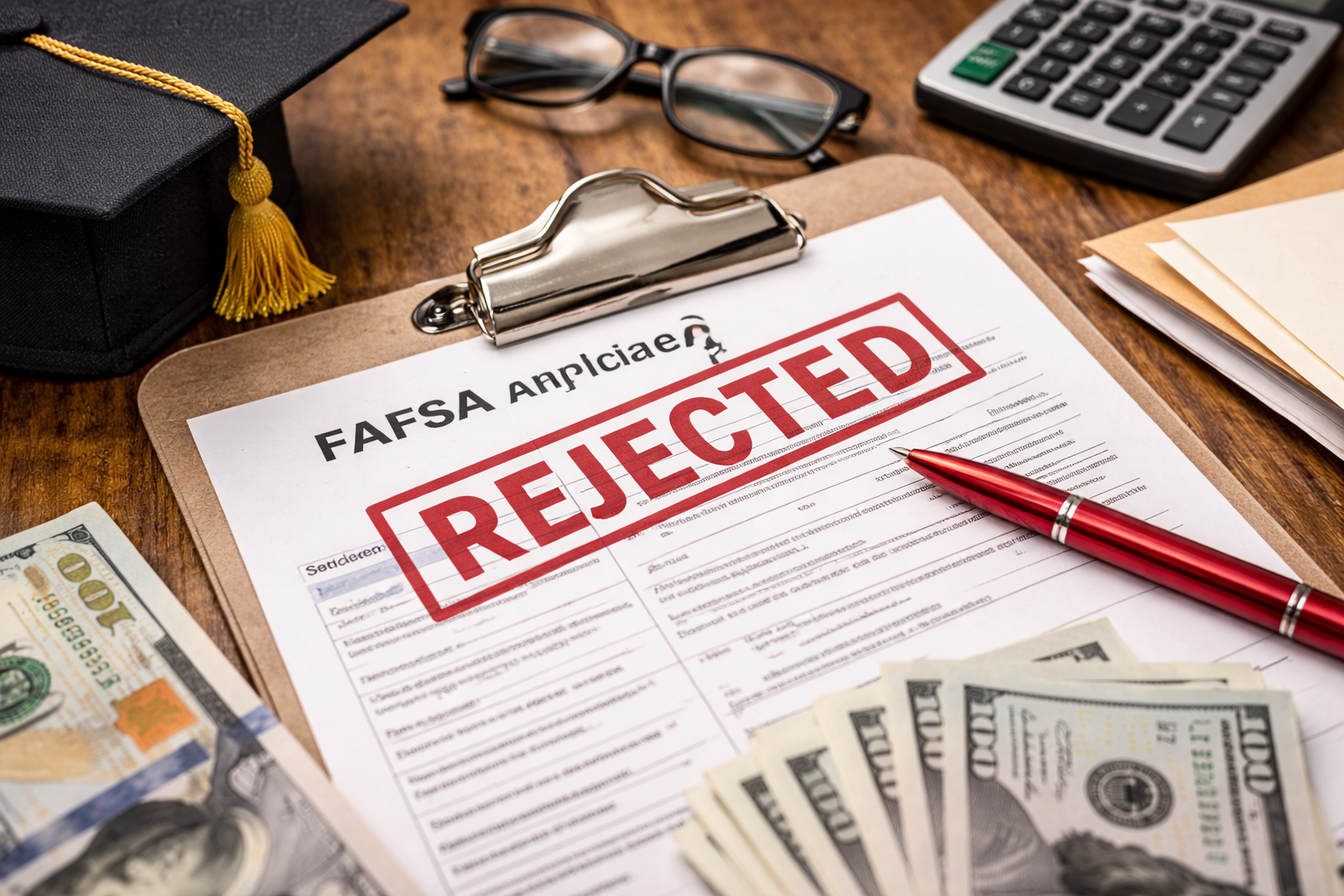
FAFSA Application Rejected — What to Do. I didn’t read that line calmly. I read it the way you read something that can change your next semester: fast, twice, and then slower the third time because your brain is already jumping to tuition dates and registration holds.
I wasn’t thinking about “the FAFSA process.” I was thinking about consequences. If the FAFSA is rejected, does the school treat you like you never applied? Does aid vanish? Do classes drop? That fear is normal. What matters is what you do next — because most FAFSA rejections are fixable, but deadlines are not forgiving.
This guide is built for U.S. students and families who need practical steps right now. If you searched FAFSA Application Rejected — What to Do, follow the sequence below. It’s designed to protect enrollment first, then fix the rejection cleanly, and prevent costly “panic moves” that create long-term debt.
If you want the fastest way to spot the typical mistakes that trigger rejection (signatures, contributors, mismatched info), this hub guide is the closest match:
What “Rejected” Usually Means (And What It Usually Doesn’t)
FAFSA Application Rejected — What to Do starts with one grounded truth: “rejected” is often a system message that the form could not be processed as submitted. It’s commonly triggered by missing confirmations, incomplete contributor steps, identity/signature issues, or mismatched information that requires correction.
In most situations, “rejected” is not the same as “ineligible.” It’s a request for action. The real risk is not the rejection itself — it’s delaying your response until school deadlines cause late fees, holds, or lost priority aid.
Common rejection triggers families run into:
- Missing signatures or consent: student or parent steps not fully completed.
- Contributor/parent section not finished: a required contributor didn’t complete their part.
- Incorrect personal data: SSN, date of birth, name formatting issues.
- IRS/data mismatch: conflicting tax information or required verification.
- Corrections that re-queue processing: edits restart review timelines.
Self-Insert Checklist (So You Stop Guessing)
Before you change anything, fill this out. It becomes your “control panel” for the next 72 hours:
- School tuition due date: ________
- Registration/housing hold risk date: ________
- FAFSA submission date: ________
- Rejection message or reason code shown: ________
- Does your school portal show verification tasks? Yes / No
- Did you save screenshots of the rejection notice? Yes / No
If tuition is due within 7 days, you must contact the school today even if corrections are not finished yet.
FAFSA Application Rejected — What to Do in the First 24 Hours
This is the “do not improvise” part. The goal is to protect deadlines while you correct the problem.
- Open your FAFSA Submission Summary and read the reason carefully.
Don’t rely on one-word portal labels. Your submission summary is usually the roadmap that tells you what to fix. - Screenshot and save proof before editing.
Save the rejection notice, date/time, and any reason code shown. Documentation prevents confusion later if a deadline is questioned. - Check for the most common fast-fix problems first.
Missing signature/consent, incomplete contributor steps, wrong SSN digits, and mismatched name formatting are frequent causes. - Confirm the correct FAFSA aid year and correct school list.
Filing for the wrong year or missing your school’s code can create downstream problems that look like rejection or “missing FAFSA.” - Start the correction process in the official portal (but edit only what you must).
Over-editing can slow reprocessing. Correct what the rejection reason targets, then stop.
At this point, FAFSA Application Rejected — What to Do becomes a two-track process: (1) fix the FAFSA, and (2) protect your enrollment while the FAFSA reprocesses.
How Colleges Handle a Rejected FAFSA (What They Can Still Do)
When FAFSA is rejected, the school usually sees your file as incomplete. That can delay an award letter. But many colleges have standard options to prevent chaos when students are waiting:
- Temporary holds on late fees for documented pending aid cases
- Short deadline extensions while FAFSA is being corrected
- Payment plans that prevent high-interest panic borrowing
- Provisional enrollment guidance if you are actively resolving the issue
Schools can’t fix your FAFSA for you, but they can often protect your account if you communicate early and clearly.
Message Template (Email That Gets a Real Answer)
Use a subject line that includes a deadline. Keep the body short and specific.
Subject: FAFSA Rejected — Tuition Deadline on [DATE] (Request for Guidance)
Hello Financial Aid Office,
My name is [STUDENT NAME], Student ID [ID]. My FAFSA for [AID YEAR] shows “rejected” due to [REASON]. I am submitting corrections on [DATE]. Tuition is due on [DATE].
What do you recommend I do now to prevent late fees or registration/enrollment holds while FAFSA reprocessing occurs?
If possible, I’m requesting [ONE: temporary late-fee hold / short extension / payment plan guidance].
Thank you, [NAME] [PHONE]
FAFSA Application Rejected — What to Do is often solved faster when the school can see you are organized and already taking action.
Long Case Block: Detailed Case Branches (Pick Your Exact Situation)
Case A: Rejected for Missing Student or Parent Signature/Consent
This is one of the most common “rejection” scenarios, and often the most fixable. The problem is that families assume the signature step is automatic when it isn’t.
- What it feels like: The form is “submitted,” but the system still flags it as incomplete.
- What to do today: Log in to both the student and parent/contributor accounts, confirm signatures/consent are completed, and save proof of completion.
- What to ask the school: “Once signatures are complete, can you note my account as pending reprocessing so I don’t receive late fees or holds?”
- Common mistake: signing on the wrong account or assuming one signature covers both roles.
After the signature fix, do not keep editing other fields unless the rejection reason requires it.
Case B: Rejected due to Incorrect SSN, Name Formatting, or DOB Mismatch
This is stressful because it feels “serious,” but it’s often a data consistency issue. Even small formatting mismatches can trigger rejection or processing failures.
- What to do: Verify all identity fields match legal documents and what is used for tax records.
- Proof step: Screenshot your correction and confirmation screen.
- School-side protection request: Ask whether enrollment can be protected while the corrected FAFSA is reprocessed.
- Common mistake: making multiple changes at once, which makes it harder to isolate the real error.
Case C: Rejected Because a Contributor/Parent Did Not Complete Their Section
This is increasingly common when families are split across households or when a contributor has login/access issues.
- First move: Confirm who is required as a contributor and whether they completed their step.
- If access is the barrier: focus only on restoring access and completing the contributor step. Don’t “work around it” with duplicate forms.
- What to tell the school: “A required contributor is completing their section today; can my account be protected while reprocessing occurs?”
- Common mistake: filing a second FAFSA to bypass the contributor step. This often delays everything.
Case D: Rejected After the School Requests Verification Documents
Sometimes the FAFSA looks “done,” but the school flags verification and then the situation feels like rejection or stoppage.
- What to do immediately: open your school portal and identify every document requested, plus the internal deadline.
- Submit fast: upload documents the same day if possible.
- If you cannot submit one item quickly: ask what alternatives are acceptable and whether an extension is possible.
- What to ask: “Once documents are uploaded, can you confirm my file is complete and my enrollment is protected while review happens?”
Verification deadlines can be more dangerous than FAFSA processing time because they may be tied to aid eligibility windows.
Case E: Rejected After You Made Corrections (Reprocessing Delay)
Corrections often restart the clock. That doesn’t mean you did the wrong thing — it means you need deadline protection while you wait.
- Do: save the correction confirmation date and any new status screenshot.
- Tell the school: “Corrections submitted on [DATE]. What interim plan do you recommend before tuition is due?”
- Common mistake: continuing to “tweak” numbers every day, which can delay reprocessing.
Case F: You’re Considering Borrowing Right Now Because You’re Afraid of Losing Enrollment
This is where families create a second problem while trying to solve the first.
- Before borrowing: ask about a payment plan or short extension.
- If you must pay something: ask what minimum payment prevents holds and whether it can be adjusted once aid posts.
- Debt warning: Short-term relief can become long-term debt if you borrow under pressure.
What Not to Do (Mistakes That Make Rejection Worse)
- Submitting multiple FAFSAs for the same year because you’re scared — this can create conflicting records.
- Ignoring school portal requests (verification tasks are often time-sensitive).
- Paying tuition with high-interest credit cards without calculating fees and interest.
- Waiting silently until the deadline hits — silence triggers automated holds.
FAFSA Application Rejected — What to Do is not “rush money.” It’s “protect enrollment first with the safest bridge option.”
Safer Short-Term Options If Tuition Is Due
- School payment plan: often the safest bridge while FAFSA reprocessing occurs.
- Short deadline extension: prevents late fees and registration issues.
- Emergency/short-term institutional support: some schools offer temporary funds for hardship.
Preserve enrollment first. Then finalize the award letter once your FAFSA is back in a valid status.
Official FAFSA Correction Resource (One Authoritative Link)
Use the official Federal Student Aid correction portal to review and correct your FAFSA safely:
Recommended Reading
If a rejection is pushing you toward borrowing decisions, this guide helps you evaluate risk before you commit:
If you want to understand upcoming changes that can affect documentation, timing, and errors:
FAQ
Is a rejected FAFSA permanent?
No. Many rejections are resolved through corrections, signatures/consent completion, or providing required documentation.
How long does it take after I correct a rejected FAFSA?
Processing timelines vary. If deadlines are near, do not wait — contact your school immediately to request a temporary plan.
Should I submit a brand-new FAFSA if mine was rejected?
Usually no. Submitting multiple FAFSAs can cause conflicts and slow everything down. Corrections are typically the safer route.
Can I keep my enrollment while FAFSA is being corrected?
Often yes, if you communicate early and request a specific accommodation (fee hold, extension, or payment plan).
What if the rejection reason is unclear?
Check your FAFSA Submission Summary and your school portal tasks. If still unclear, contact your school and ask what they see on their end.
Key Takeaways
- FAFSA Application Rejected — What to Do is about correcting the right issue and protecting deadlines at the same time.
- Most rejections stem from fixable items like signatures, contributor steps, or data mismatches.
- Document everything before you edit so you can prove actions and dates if needed.
- Communicate early with your school and request one clear accommodation (fee hold, short extension, payment plan).
- Avoid panic moves like duplicate FAFSAs or high-interest “quick fixes.”
I didn’t feel “relieved” the moment the corrections were submitted. What changed first was the risk. Once the school had documentation and a clear request, the account became protected while the FAFSA caught up.
If you searched FAFSA Application Rejected — What to Do, your next best move is simple: open your submission summary today, fix only what the rejection reason targets, and email your school with the tuition deadline and one specific request for a temporary plan.