
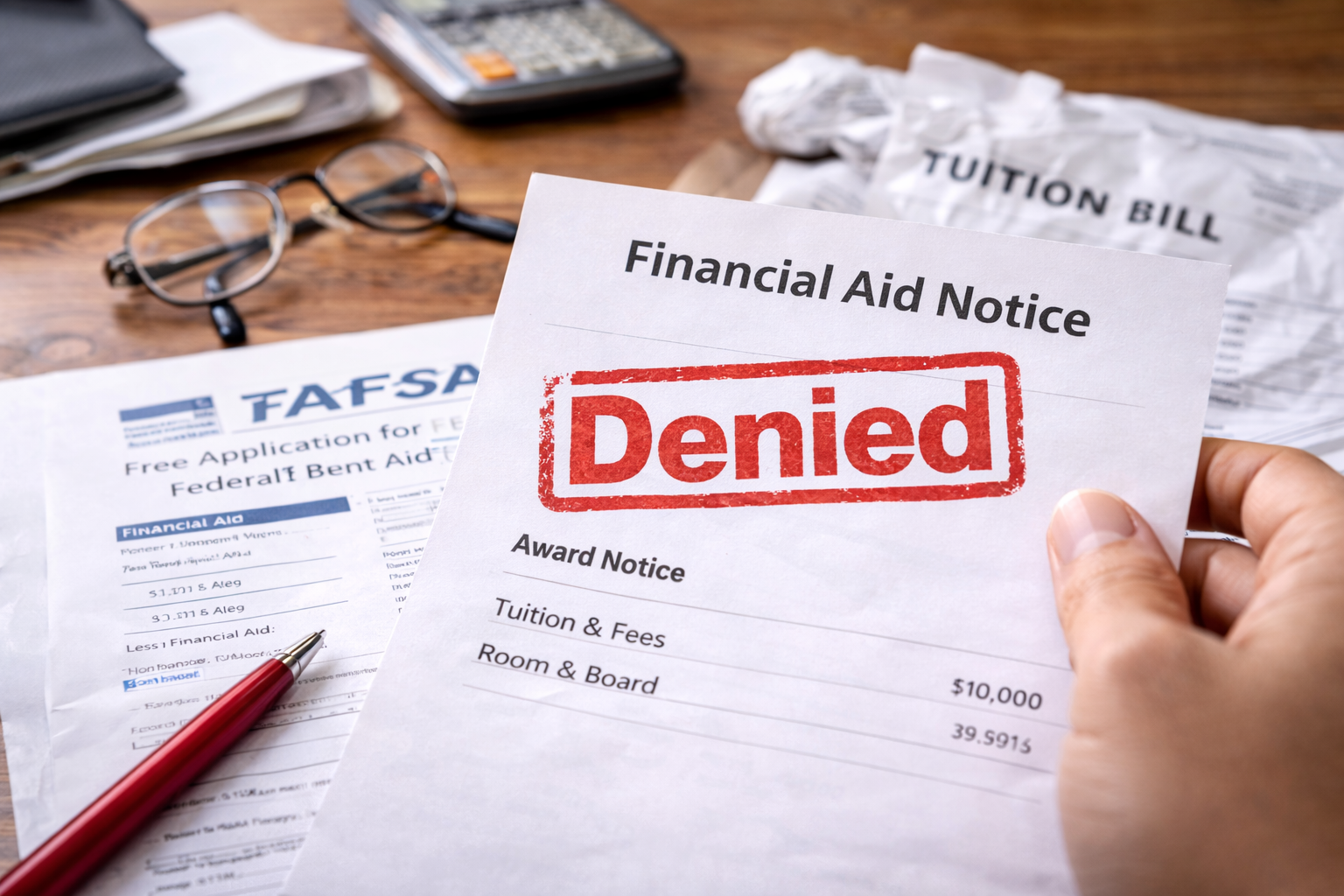
Financial Aid Denied what to do is a question families usually ask in panic. You planned your college budget around financial aid, and suddenly the award letter says “denied,” “ineligible,” or shows an amount far lower than expected. Tuition deadlines don’t pause just because the answer was disappointing.
Here’s the most important thing to understand first: a denial is often a data problem or a timing problem, not a permanent judgment. This guide walks through the system logic behind denials, what schools can and cannot change, and how to protect yourself from making rushed decisions that create long-term financial damage. This is educational information for U.S. students and parents, not legal or personalized financial advice.
What to do in the first 24 hours
When aid is denied, speed matters—but only if it’s organized speed. Start with these actions:
- Identify the aid type: federal (Pell, loans), state, or institutional.
- Check FAFSA status: processed, rejected, or selected for verification.
- Look for appeal instructions buried in the award notice.
- Mark all deadlines for appeals, verification, and tuition deposits.
Do not borrow or commit to a payment plan yet. Many families searching Financial Aid Denied what to do later regret acting before understanding the reason behind the decision.
Why financial aid is denied (how the system actually works)
Financial aid decisions are driven by formulas and compliance rules. Common system-level triggers include:
- Income spikes: bonuses, overtime, capital gains, or retirement withdrawals counted as income.
- FAFSA inconsistencies: tax filing status, household size, or parent marital status mismatches.
- Verification failure: documents submitted late or missing signatures.
- Asset reporting errors: 529 plans, custodial accounts, or small business assets entered incorrectly.
- SAP issues: GPA or credit completion rules not met in prior semesters.
Understanding which bucket applies determines whether an appeal is likely to work. This step separates families who recover aid from those who assume Financial Aid Denied what to do means “no options left.”
How financial aid offices evaluate appeals
Appeals are reviewed under something called “professional judgment.” Aid officers typically ask:
- Did circumstances change after the FAFSA year?
- Is the documentation verifiable and specific?
- Does the change affect ability to pay?
- Is institutional funding still available?
They are not re-running the FAFSA to be nice. They are deciding whether your situation falls outside the standard formula. Clear evidence beats emotional explanations every time.
Your rights as a student or parent
You are entitled to transparency, even if the answer stays “no.” Your rights include:
- Requesting a written explanation of how eligibility was calculated.
- Submitting corrected information if errors exist.
- Requesting reconsideration due to special circumstances.
- Reapplying in future years if finances change.
Asking questions does not hurt your file. Families who calmly seek clarification often uncover fixable issues when searching Financial Aid Denied what to do.
How to write an effective appeal (what actually works)
Successful appeals are short, factual, and documented. Use this structure:
- State the issue: “Our aid was denied/reduced due to income reported for 2023.”
- Explain the change: job loss, medical expenses, divorce, death, disaster.
- Attach proof: termination letters, bills, tax amendments.
- Explain impact: how the change affects ability to pay now.
- Close respectfully: request reconsideration, not a guarantee.
Appeals are strongest when they explain timing—why last year’s numbers no longer represent today’s reality.
When appeals fail: realistic backup options
If aid truly does not change, you still control the financial damage. Options include:
- School payment plans that avoid interest.
- Institutional scholarships that reopen midyear.
- Cost-based school comparisons before committing.
- Careful borrowing with full repayment awareness.
The worst outcome is borrowing blindly under pressure. A denial should trigger planning, not panic.
Mistakes that permanently hurt finances
Avoid these common reactions:
- Skipping appeals because “it won’t work.”
- Borrowing private loans first without understanding terms.
- Missing SAP rules after enrollment.
- Ignoring next-year strategy for income and assets.
Many families make their situation worse after denial, not because of the denial itself.
One official resource to rely on
For accurate federal guidance on eligibility, appeals, and aid types, use the official student aid portal.
Key Takeaways
- Denial is often fixable with corrections or appeals.
- Appeals succeed with documentation, not emotion.
- Deadlines control outcomes.
- Backup plans prevent long-term debt mistakes.
FAQ
Does financial aid denied mean I can’t attend college?
No. It means aid was limited from that source. Many students attend through appeals, alternative aid, or different schools.
How long do appeals usually take?
Most reviews take 2–6 weeks, depending on the school and documentation.
Can aid be denied one year and approved the next?
Yes. Changes in income, assets, or family size can significantly affect eligibility.
Is there a downside to appealing?
No. Appeals do not harm eligibility or academic standing.
Final reminder: If you are searching Financial Aid Denied what to do, remember this—denial is a checkpoint, not a dead end. Understanding the system and responding strategically can still make college affordable.
Recommended reading (internal)
FAFSA errors — Small mistakes that block or reduce aid.
Income limits explained — How income actually affects aid.
Financial aid offer too low — What to do when the award isn’t enough and how to request reconsideration.