
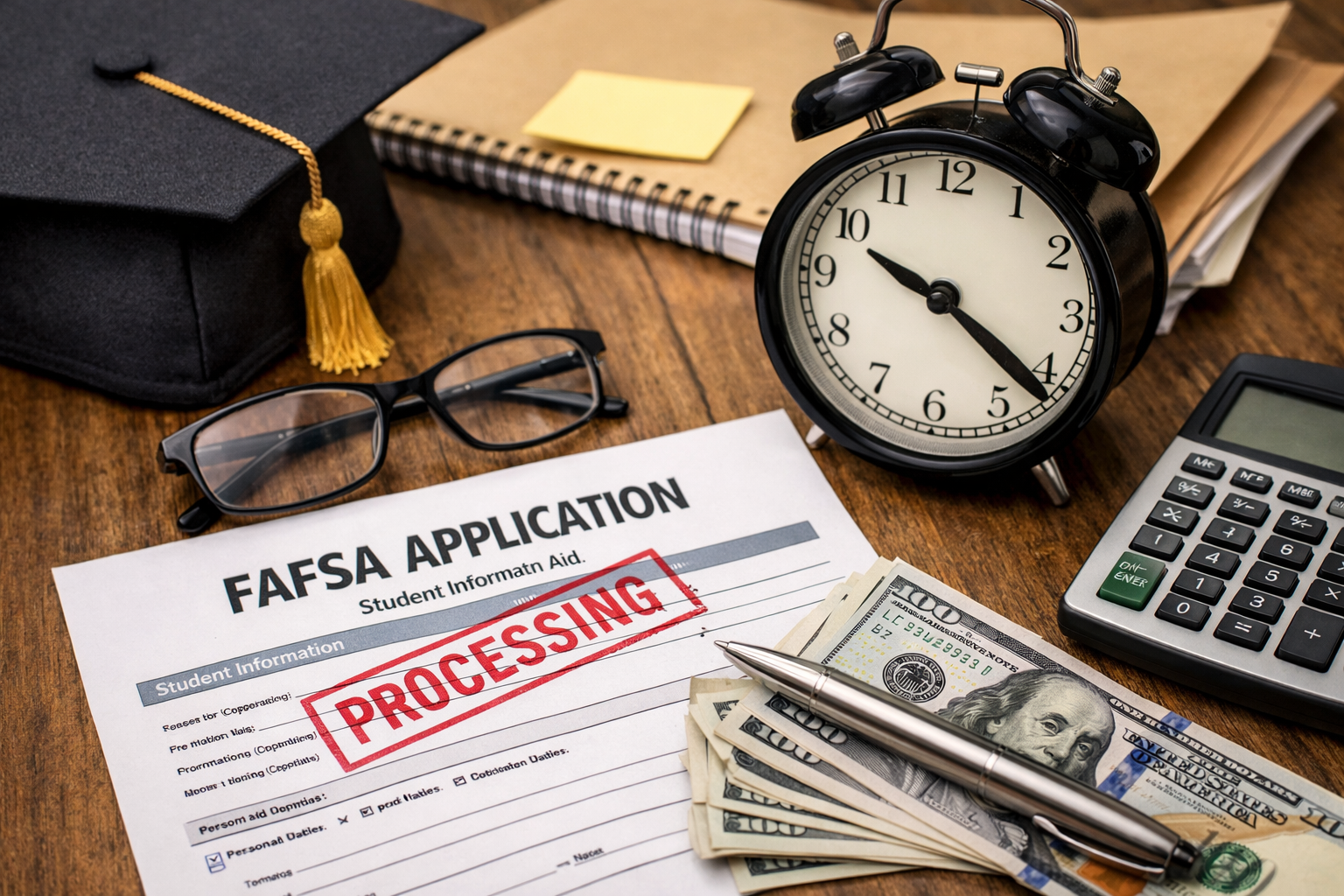
FAFSA processing delay — what to do. I typed that phrase with one hand while refreshing the school portal with the other. The bill had a due date, the portal had a warning banner, and my FAFSA status still sat there like it was frozen in time: “processing.”
I wasn’t looking for motivation. I was looking for a way to keep the student enrolled, avoid late fees, and prevent a desperate decision that turns into long-term debt. If you’re here, you probably need a plan you can execute in the next 24–72 hours.
This is that plan. No textbook definitions. No “it depends” fluff. Just a deep, practical sequence for U.S. families dealing with a real deadline while the FAFSA remains stuck.
If you suspect a small filing mistake triggered your delay, this is the closest hub guide to troubleshoot the most common causes quickly:
Why FAFSA Gets Stuck in “Processing” (What Usually Triggers the Pause)
FAFSA processing delay — what to do starts with a calm truth: most delays aren’t personal. They’re procedural. That doesn’t make them harmless — it just means you fix them by working the process, not by worrying.
Here are the most common triggers families miss because the portal doesn’t always shout them in plain English:
- High volume windows: After priority deadlines, weekends, and major updates, processing times stretch. You can be “fine” and still be slow.
- Signature issues: A missing parent signature or student signature can look like “processing” even when it’s basically paused.
- Identity confirmation: If the system needs identity verification, it may not progress until that step is done.
- Data mismatches: Small differences (name format, SSN typo, DOB mismatch) can trigger review. Even “Jr.” or a hyphenated name can cause friction.
- School verification: The FAFSA can be submitted, but the school may flag verification and request documents before finalizing aid.
- Corrections and reprocessing: If you made a correction, your file may re-enter a queue.
A delay is a timing problem first. Your strategy must protect deadlines while you fix the processing issue.
What a FAFSA Delay Means at the College Level (How Schools Think)
When the FAFSA is delayed, the financial aid office often can’t produce a final award letter. But schools still have to run billing, enrollment, housing, meal plans, and class registration — on schedule.
So the school tends to separate students into two buckets:
- Students who communicate early with documentation: easier to help, more likely to receive a temporary hold or extension.
- Students who go silent until the due date: more likely to face automated late fees or holds, because nobody flagged the account as “pending resolution.”
FAFSA processing delay — what to do at the college level is about making your account “administratively safe.” You want a note in the system that says: FAFSA pending, family contacted, temporary plan in place.
Self-Insert Checklist (So You Can Apply This to Your Exact Situation)
Before you do anything else, take 3 minutes and answer these. This is how you stop guessing and start acting:
- Tuition due date: ________
- Housing/registration hold risk date: ________
- FAFSA submission date: ________
- Status shown today: “________”
- Is there an “Action Required” notice? Yes / No
- Does the school portal show verification tasks? Yes / No
- Do you have screenshots saved? Yes / No
If tuition is due in 7 days or less, you must work the school process in parallel today.
FAFSA Processing Delay — What to Do Now (The 7-Step Sequence)
This is the core answer to FAFSA processing delay — what to do. Do these in order. Do not skip the documentation steps — they are what makes your request easy to approve.
- Confirm your FAFSA status and the correct aid year.
Log in and verify you filed for the correct year. Screenshot the status page and the submission date/time. Save it in a folder named “FAFSA Proof.” - Scan for “hidden” missing actions.
Look for anything that implies incomplete steps: missing signatures, identity confirmation, “action required,” or a prompt to re-enter consent. One missing click can keep you stuck for weeks. - Open the school portal and check the to-do list carefully.
Don’t skim. Some portals bury verification items under “Financial Aid Requirements” or “Documents.” If you see verification tasks, write down exactly what is requested and the deadline. - Prepare a clean 5-line email that gets a fast response.
Use a subject like: “FAFSA Still Processing — Tuition Deadline on [DATE].” In the body include: student name, student ID, program/term, submission date, and a single question: what should we do before the deadline to prevent holds? - Ask for one accommodation (not five).
Choose the single best request for your situation:- Temporary hold on late fees
- Short extension of the tuition deadline
- Permission to enroll / register while aid is pending
- Payment plan option that avoids high-interest borrowing
Specific requests are easier for staff to approve.
- Document every response and follow the school’s preferred channel.
If they say “upload documents in portal,” do that. If they say “call billing,” call billing. The goal is not to argue — it’s to close the loop quickly. - Set a follow-up schedule and stick to it.
Follow up every 5–7 business days, or sooner if the due date is within 72 hours. Silence is the biggest risk factor when deadlines are near.
If you only remember one line: FAFSA processing delay — what to do is “verify, document, contact, request a deadline-safe plan, follow up.”
Email Template That Works (Copy/Paste)
Subject: FAFSA Still Processing — Tuition Deadline on [DATE]
Hello Financial Aid Office,
My name is [STUDENT NAME], Student ID [ID]. My FAFSA for [AID YEAR] was submitted on [DATE], but it still shows “processing.” Tuition is due on [DATE].
What do you recommend I do now to prevent late fees or enrollment/registration holds while aid is pending?
If possible, I’m requesting [ONE: temporary late-fee hold / short extension / payment plan guidance].
Thank you, [NAME / PHONE]
Long Case Block: Detailed Case Branches (Pick Your Exact Scenario)
Case A: Tuition due within 72 hours
This is where families make expensive mistakes. Your goal is to stop automated consequences today.
- Do today: email financial aid + call the billing office (or student accounts) if your school splits responsibilities.
- Ask for: a temporary late-fee hold and confirmation you won’t lose classes/housing due to pending aid.
- Bring proof: screenshots of FAFSA status + portal to-do list + submission date.
- If they offer a payment plan: ask whether the plan can be adjusted once aid posts (some schools allow recalculation).
Do not put tuition on a credit card “just to buy time” unless you’ve calculated the fees and interest and you have a repayment plan.
Case B: Your portal shows verification documents
A FAFSA delay often becomes a school verification delay. These are not the same thing.
- Do first: upload requested documents immediately (even partial uploads with a note can sometimes protect deadlines).
- Ask: “Can you confirm my file is complete once these are uploaded?” and “Is there an internal deadline for verification completion?”
- If you’re missing a document: ask what alternatives are accepted (for example, a signed statement, an IRS transcript alternative, or a document request extension).
Verification delays can cost aid eligibility if internal school deadlines are missed — even when FAFSA itself is fine.
Case C: You corrected the FAFSA and now everything slowed down
Corrections often send you back into a queue. That doesn’t mean you did the wrong thing — it means you need timeline protection.
- Do: save proof of the correction date.
- Tell the school: “A correction was submitted on [DATE]. Can you advise what protections apply while the corrected FAFSA is reprocessed?”
- Ask for: a temporary enrollment-safe plan if billing deadlines are near.
Case D: Parent can’t access FSA ID / signature problems
If one account can’t sign or consent, the FAFSA can stall without obvious messaging.
- Do: verify parent/student can log in successfully and that consent/signature steps are complete.
- Fix first: the missing signature/consent step, then screenshot completion.
- Tell the school: “Signature issue resolved today; FAFSA reprocessing is pending.”
Case E: You’re considering borrowing because you’re scared of losing enrollment
This is the “financial trap” branch. Families borrow fast, then regret slow.
- Do: confirm whether a payment plan or short extension is available before using loans or credit cards.
- Ask: “Will my classes/housing be protected if I enroll on a payment plan while aid is pending?”
- Use borrowing only as a last step: and only after you understand repayment terms.
What NOT to Do (Costly Mistakes That Create a Second Problem)
- Submitting duplicate FAFSAs: this can reset processing and confuse records.
- Ignoring the school portal: verification items are often posted there first.
- Paying by credit card without a plan: fees + interest can become permanent even if aid arrives later.
- Waiting until the last day to contact the school: time pressure removes options.
FAFSA processing delay — what to do is not “take the fastest money.” It’s “protect enrollment first with the safest short-term option.”
If Tuition Is Due: Safer Short-Term Options That Keep You Enrolled
- School payment plan: typically the lowest-risk bridge while aid is pending.
- Temporary extension: prevents late fees and registration holds.
- Emergency/short-term institutional support: some campuses have hardship funds.
Your goal is not to “win the argument.” Your goal is to keep the student active in the system while the paperwork catches up.
Official FAFSA Status Resource (One Authoritative Link)
For official FAFSA information and status guidance, use the Federal Student Aid site:
Recommended Reading
If this delay is pushing you toward borrowing decisions, read this before you commit to a loan pathway:
If you want to understand how rule changes can affect timing, documentation, and planning:
FAQ
How long does FAFSA processing usually take?
It depends on season and whether your file is flagged for review. Treat the timeline as uncertain when tuition deadlines are near and work with the school in parallel.
Can I still enroll if my FAFSA is delayed?
Often yes. Many schools can place temporary protections if you contact them early and provide proof of submission.
Should I submit another FAFSA if it’s taking too long?
Usually no. Duplicate submissions can slow things down. Instead, verify missing steps, check alerts, and contact the financial aid office.
What if my school asks for verification documents?
Submit them quickly and keep copies. If you can’t provide something immediately, ask what acceptable alternatives exist and whether your account can be protected while you gather documents.
What if tuition is due tomorrow and I have no award letter?
Ask for a short extension or payment plan today, and request a temporary hold on late fees. Avoid rushing into high-interest borrowing unless you fully understand the terms.
Key Takeaways
- FAFSA processing delay — what to do is a deadline-management problem: verify, document, contact, request one clear accommodation, and follow up.
- Delays usually mean “pending,” not “denied,” but waiting quietly can trigger holds, late fees, and enrollment issues.
- Choose the safest bridge first: payment plan, extension, or temporary hold — not panic borrowing.
- Avoid duplicate FAFSAs and credit-card “quick fixes” that create permanent debt.
- Follow up on a schedule until the award is finalized and your student account is clear.
When I finally stopped refreshing the portal and started working the school process, things changed. Not instantly — but the account became protected. The risk went down. The staff responses got clearer.
If you searched FAFSA processing delay — what to do, your next best move is to send the email today with the deadline date and one specific request. Don’t wait for the system to be ready before you protect enrollment.