
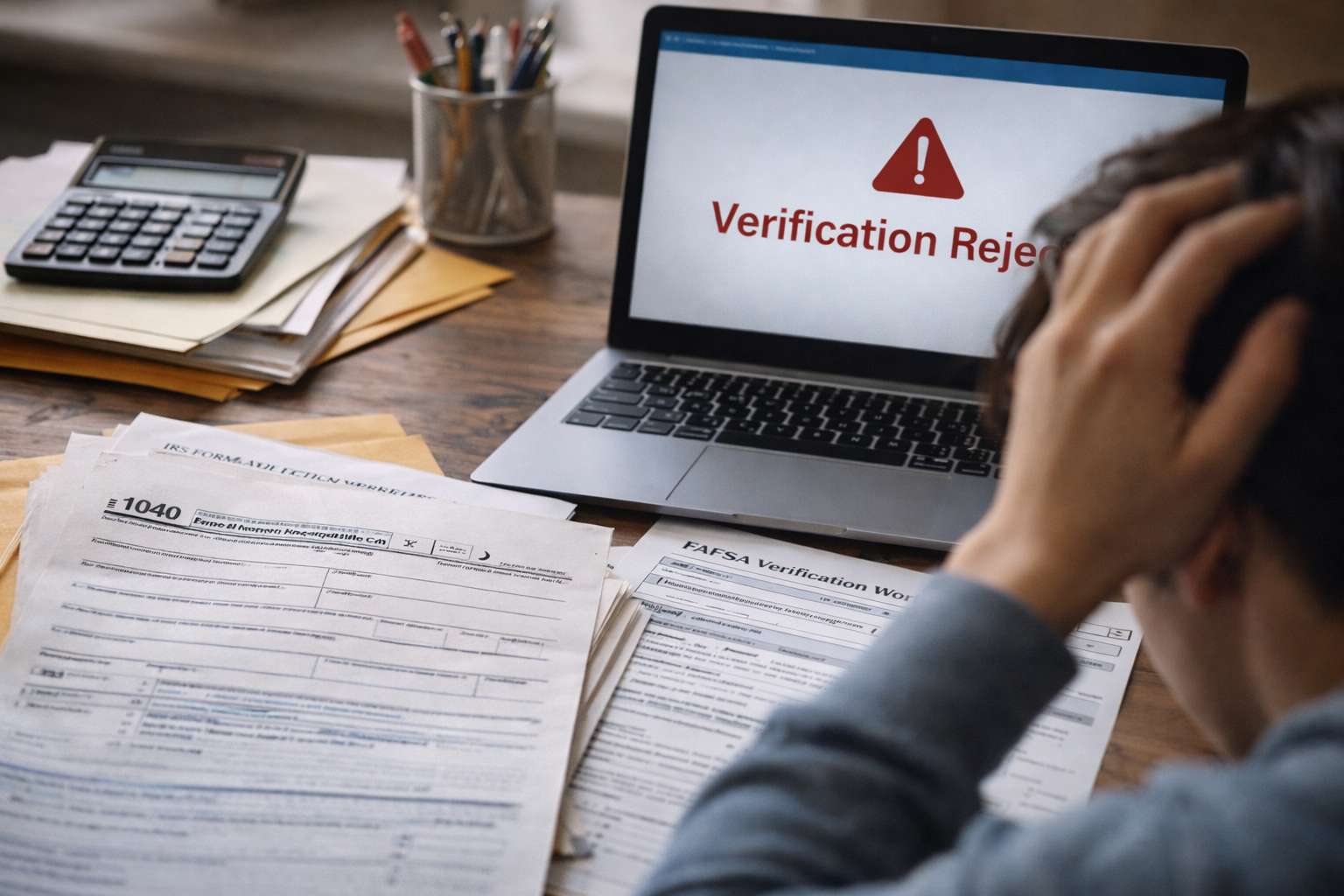
Financial aid verification rejected — that was the first time I realized something had gone seriously wrong.
I wasn’t expecting good news or bad news. I was just checking my aid portal out of habit. Then the status wasn’t “pending” anymore. It wasn’t “under review.” It said rejected. No warning. No follow-up email. Just a status change that quietly pulled the financial support out from under everything else. It didn’t feel like a delay. It felt like a stop.
This guide is written for that moment. Not for when verification is selected. Not for when documents are missing. This is for when the system has already made a decision — and now you need to understand what that decision means and how to reverse it before aid is reduced, frozen, or permanently lost.
Verification rejection almost always comes after the selection stage. If you want to understand how and why students are selected for verification in the first place, this overview provides useful context.
What “rejected” actually signals inside the aid system
When a school marks financial aid verification rejected, it is not asking for more time or more patience. It is signaling that the verification review has ended and that the information provided could not be validated.
This status is fundamentally different from “pending” or “incomplete.” Pending means the school is still reviewing. Incomplete means something is missing. Rejected means the data was reviewed and found inconsistent or unreliable. At this point, aid is often frozen and disbursement stops.
Many students assume the school will automatically ask for clarification. In practice, the system stops and waits for the student to initiate the correction.
Why schools reject verification instead of continuing review
Financial aid offices operate under strict federal compliance rules. Disbursing aid based on conflicting information can trigger audits, penalties, and repayment demands. Because of that risk, schools set internal thresholds.
If discrepancies exceed those thresholds, the safest option is to reject verification rather than continue requesting documents. That’s why financial aid verification rejected is often a compliance decision, not a judgment of intent.
The goal is to stop incorrect aid before money moves.
The most common patterns behind verification rejection
Rejection usually does not happen because of a single missing signature. It happens when multiple data points fail to align.
- FAFSA income numbers do not match IRS tax transcripts
- Household size differs across FAFSA, CSS Profile, and school forms
- Non-filer status is claimed without IRS confirmation
- Marital status changes are not consistently reported
- Untaxed income appears in one system but not another
- Amended tax returns are not reflected correctly
Mismatch, not omission, is the usual trigger.
What the financial aid office sees vs what you experience
From the aid office’s perspective, a rejection is procedural. Their system flags conflicts that exceed acceptable tolerance levels.
From the student side, financial aid verification rejected feels abrupt and destabilizing. Aid disappears from the portal. Bills remain. Enrollment decisions suddenly feel uncertain.
The disconnect is information. The school knows exactly what failed. You usually don’t — until you ask the right questions.
Your rights after verification is rejected
Rejection does not remove your rights or your options. You are still entitled to clarity and a defined path forward.
- You can request the exact discrepancy that caused rejection
- You can ask whether FAFSA correction is required
- You can ask if resubmission of documents is allowed
- You can request professional judgment if circumstances changed
Those rights are time-sensitive. Waiting too long narrows your options.
What to do immediately when rejection appears
If your portal shows financial aid verification rejected, random action will slow resolution. Order matters.
- Step 1: Contact the financial aid office and ask which data point caused rejection.
- Step 2: Confirm whether the issue requires FAFSA correction or document replacement.
- Step 3: Ask whether your aid is frozen or already canceled.
- Step 4: Confirm the final deadline to resolve the issue.
Do not resubmit documents before Step 1 is clear.
If the rejection involves conflicting paperwork, this checklist helps align documents before resubmission.
Case branching: match your rejection to the correct fix
This is where most students lose time. The correct action depends on why rejection occurred.
- Income mismatch: Correct FAFSA income to match IRS records exactly.
- Household size conflict: Align FAFSA, CSS Profile, and school forms line by line.
- Non-filer issue: Submit IRS verification of non-filing letter.
- Recent income change: Request professional judgment review.
- Dependency disagreement: Ask about dependency override documentation.
Each branch requires a different document strategy. Treating them the same delays approval.
What happens if rejection is ignored
Ignoring a financial aid verification rejected status carries real consequences.
- Aid can be permanently canceled for the term
- Future disbursements may be blocked
- Registration or enrollment holds may appear
- Outstanding balances may transfer to billing
Rejection without response often becomes denial.
Official guidance you can reference
Federal Student Aid outlines verification responsibilities and correction rules.
What to do right now
Log in today. Identify why verification was rejected. Call the aid office. Ask exactly what must be corrected. Confirm deadlines. Then act deliberately.
A financial aid verification rejected status is not final — but delay can make it final.
If rejection escalates to full aid loss, this explains what to do next.
Key Takeaways
- Verification rejection means review stopped, not delayed
- Correction is faster than explanation
- Deadlines matter more after rejection
- Aligned data is the fastest path forward
FAQ
Is verification rejection permanent?
No. Most schools allow correction or resubmission if deadlines are met.
Will my aid disappear immediately?
Often aid is frozen first, then canceled if no action is taken.
Should I resend the same documents?
No. Correct the conflicting data first.
Can I appeal?
Yes, especially if your financial situation changed.
Most appeals fail not because of eligibility, but because the documentation wasn’t structured the right way.